The Definitive Guide to Suing Robocallers Under TCPA
Robocalls violate federal law. Learn how to document violations, unmask callers, and secure $500–$1,500 per violation—often without a lawyer.
Understanding TCPA Violations and Your Rights
The Telephone Consumer Protection Act (TCPA) empowers consumers to pursue damages of $500 per non-willful violation or up to $1,500 per willful one (such as repeat calls or ignoring opt-outs).
The TCPA prohibits automated calls, texts, or faxes without prior express consent, including those using autodialers (ATDS), prerecorded voices, or artificial intelligence.
Common TCPA Violations
- Calls to cell phones without consent
- Texts sent via automated systems
- Calls outside 8 AM–9 PM local time (quiet hours)
- Ignoring opt-out requests or Do Not Call listings
Successful claims can yield uncapped damages—e.g., $186,000 from 124 willful texts at $1,500 each. Courts award based on strict liability, meaning intent isn't always required, but willful cases (repeats or known non-consent) triple payouts.
Why Spammers Don't Expect Pushback
Robocallers operate on scale, blasting millions cheaply while hiding via spoofing or overseas proxies.
They assume victims will block or ignore rather than act, given low complaint rates and slow FCC enforcement.
When faced with documented demands, many settle to avoid court fees, publicity, and escalating penalties—often paying $500–$1,500 per violation pre-trial.
Common Barriers to Taking Action—and How to Overcome Them
Most don't pursue claims due to:
- Unawareness of rights or potential $500+ per violation
- Tedious manual documentation (logs, transcripts)
- Difficulty unmasking hidden callers
- Perceived complexity of demands or small claims
Overcome by automating evidence collection and starting small: Focus on high-volume patterns where damages multiply.
Step-by-Step: How to Sue Robocallers Effectively
Follow these steps precisely for maximum impact. Prioritize accuracy, organization, and persistence—effective claims rest on undeniable proof.
-
Register and Establish Consent Rules
Sign up for the National Do Not Call Registry at donotcall.gov (effective after 31 days). Revoke consent for any prior permissions by texting "STOP" or verbally opting out during calls. Document these actions with screenshots or recordings.
Tip: Track all interactions from day one—violations post-opt-out qualify as willful for higher damages. -
Document Violations Thoroughly
Log every spam call/text: Timestamp, caller ID, content, duration, and metadata (e.g., ATDS indicators like pauses or robotic voices). Save voicemails, transcripts, and phone records.
Effectiveness tip: Use tools for automatic capture to avoid errors—manual notes often miss patterns like number rotation, weakening cases. -
Identify and Unmask the Caller
Use reverse lookups (e.g., WhoCallsMe, TrueCaller) or FCC traces to reveal true origins beyond spoofed numbers. Subpoena carriers if needed (via small claims).
Tip: Look for patterns like campaign scripts or upstream routes—collective data from similar victims accelerates this, revealing defendants. -
Calculate Damages Accurately
Tally violations: $500 base per non-willful; $1,500 for willful (repeats, no consent, quiet hours breaches). Include actual harms like privacy invasion.
Tip: Use calculators or apps for precision—underestimating weakens demands. -
Send a Demand Letter First (Often Sufficient)
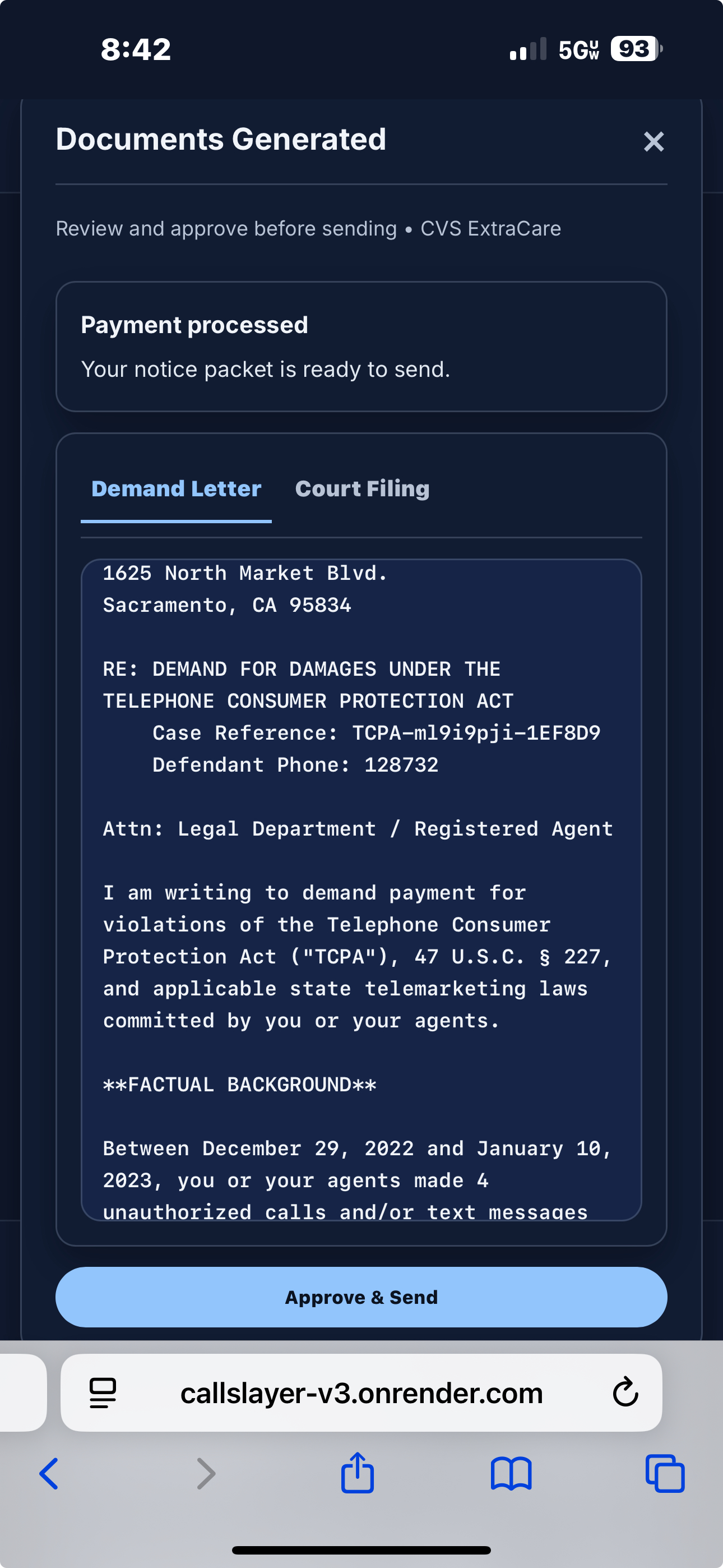
Draft a professional letter outlining violations, evidence, damages calculation, and settlement demand. Include exhibits (logs, transcripts). Send via certified mail for proof.
Effectiveness tip: Be factual, not emotional—cite TCPA sections, demand response within 14–30 days, and warn of lawsuit. Many settle here. -
File a Lawsuit If No Settlement
Use small claims court (DIY in most states, limits $5K–$25K). File complaint with evidence; serve defendant.
Tip: Choose venue wisely (your state or federal for larger claims). Many cases settle post-filing. -
Enforce and Collect
If you win, use judgments for garnishment if unpaid.
Tip: Include attorney fees in claims if consulting one.
How CallSlayer Automates the Process for Maximum Effectiveness
Manual methods are error-prone and time-consuming—CallSlayer transforms them into an automatic, efficient system, making TCPA claims accessible and powerful for anyone.
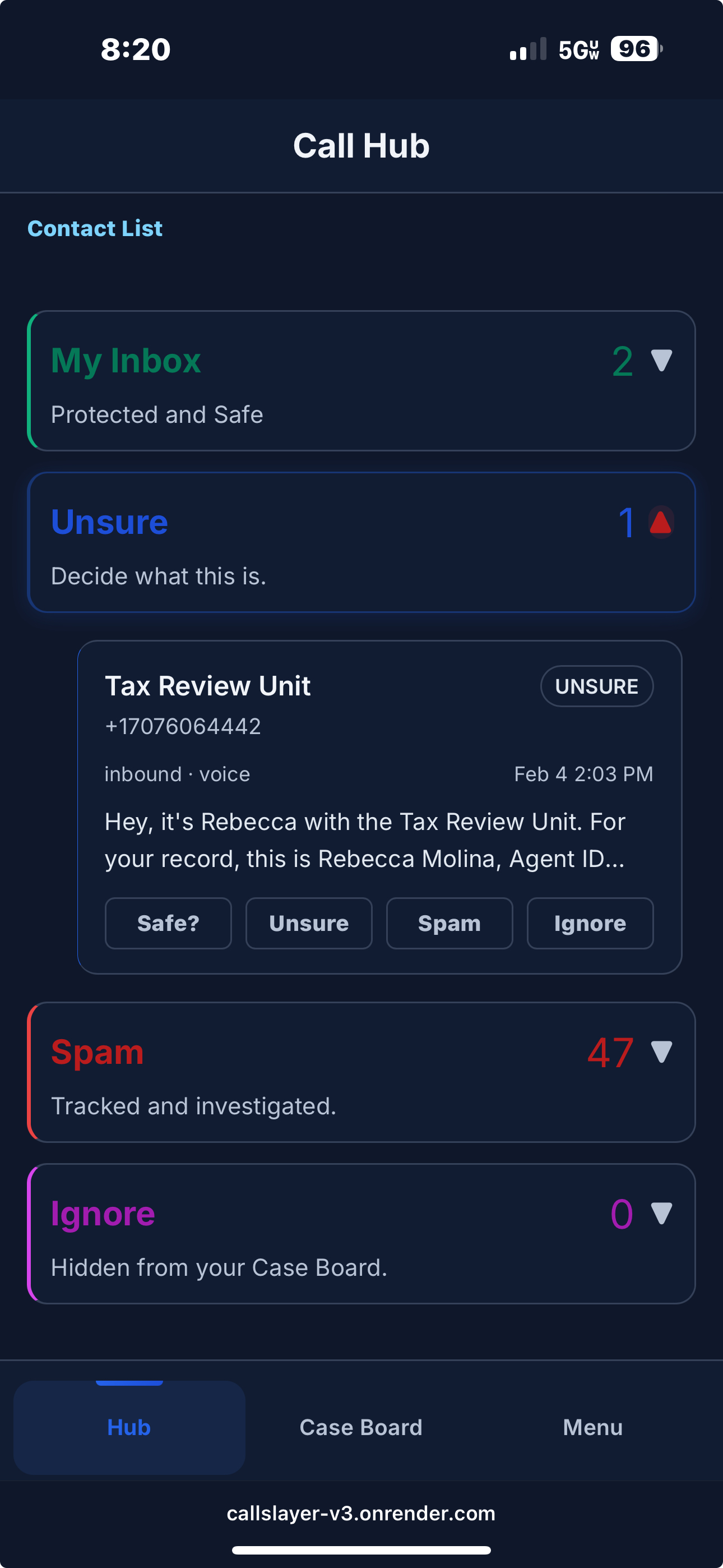
Automatic Spam Filtering and Detection
Runs in the background to screen unknowns, detect ATDS, prerecorded voices, or AI scripts—flagging violations instantly without user intervention. This ensures no missed logs, capturing metadata like timestamps and patterns for airtight proof.
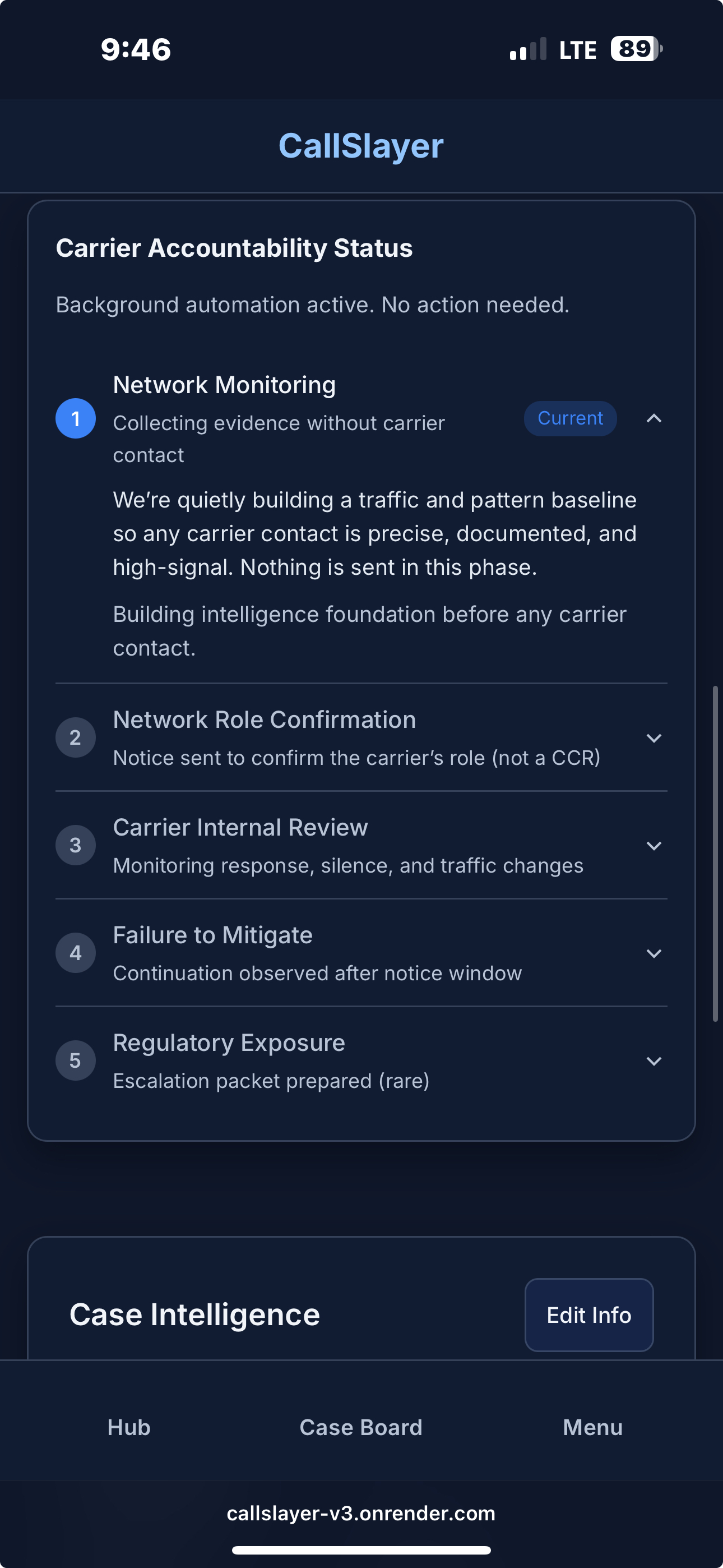
Unmasking Callers Through Intelligent Analysis
Uses traffic correlation, upstream routing, and defendant mapping to reveal hidden origins (e.g., carriers, companies). Partial intel builds over time, turning spoofed numbers into identifiable entities for demands.
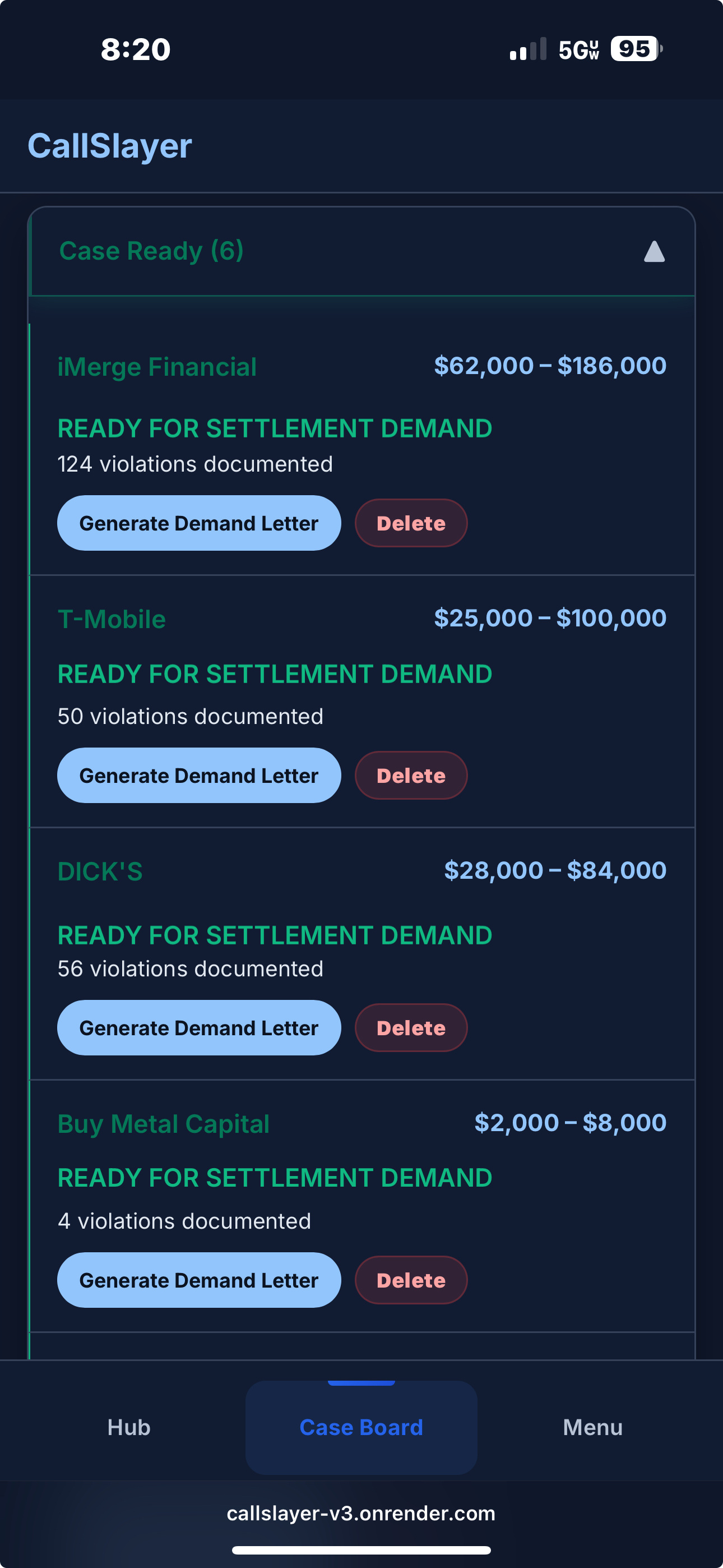
Compiling Cases Seamlessly
Auto-generates case boards with transcripts, evidence summaries, and damages breakdowns (e.g., $1,000–$4,000 from 2 violations). Exports ready exhibits for letters or filings, calculating statutory exposure accurately.
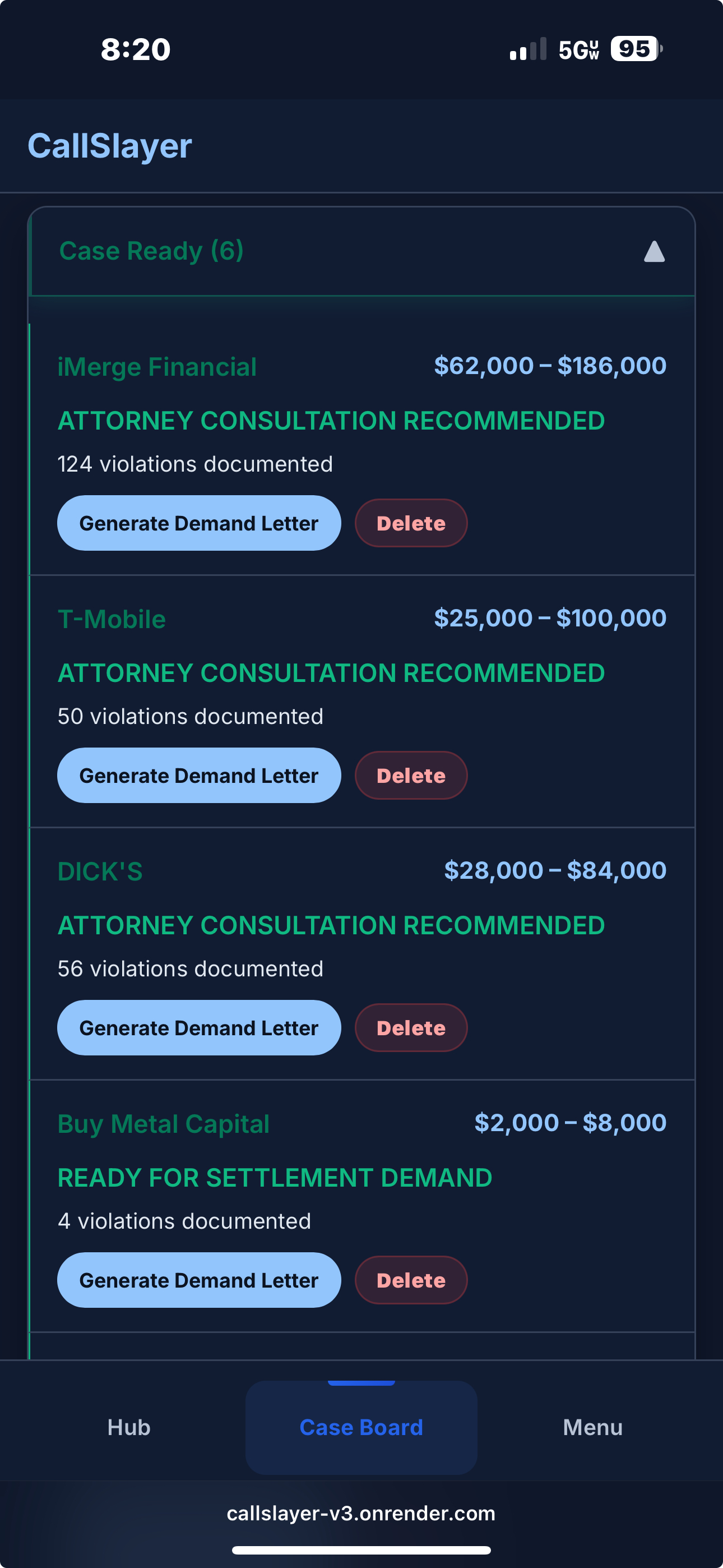
Leveraging the Crowd Effect for Stronger Cases
As users log similar patterns (e.g., identical tax scams), the shared intelligence database correlates them anonymously—promoting low-signal cases to high-strength ones. This crowd-powered escalation uncovers campaigns, strengthens willfulness proof, and boosts settlement odds without individual effort.
Collective data reveals repeat offenders faster, making demands more credible and effective.
With CallSlayer, what once required spreadsheets and subpoenas now builds automatically—often leading to demand-letter resolutions as evidence overwhelms spammers.
Success Stories and Resources for Inspiration
Real wins prove the process works:
$100,000+ from 50+ Small Claims
A Texas CPA collected over $100,000 by documenting persistently and filing small claims.
$20,000 at Age 16
A teen earned $20,000 settling 25 cases via demand letters.
$9.25M Class Action
Navy Federal settlement shows the scale of TCPA enforcement.
YouTube Resources for Guidance
- "How He Made $20,000 From RoboCallers at 16 Years Old!" (Inside Edition) – Demand strategies
- "State of Texas: Meet the Texas man who has made $75,000 suing telemarketers" – Small claims tips
- "Man wins thousands by suing telemarketers; here's how you can" (Nexstar) – Step-by-step
Settlements range from $1K individual payouts to multimillion class actions.
Empower Yourself Against Spam
This guide equips you to pursue TCPA claims effectively—start with automation for unbeatable evidence.
Turn violations into victories today.
Filter spam, unmask callers, compile cases automatically